Intercom Source Connector
The Intercom Source Connector allows you to integrate Intercom conversations, help articles, external pages, users, and teams as a data source for your pipelines. This connector retrieves content from your Intercom workspace based on various filtering criteria, making it ideal for processing customer support data, knowledge base content, and team information for your AI applications.
Before you begin
Before starting, you'll need:
- An authorized connection to your Intercom workspace (handled during setup)
Configure the connector
To configure a connector to your Intercom workspace:
- Click Source Connectors from the main menu.
- Click New Source Connector from the Source Connectors page.
- Select the Intercom card.
-
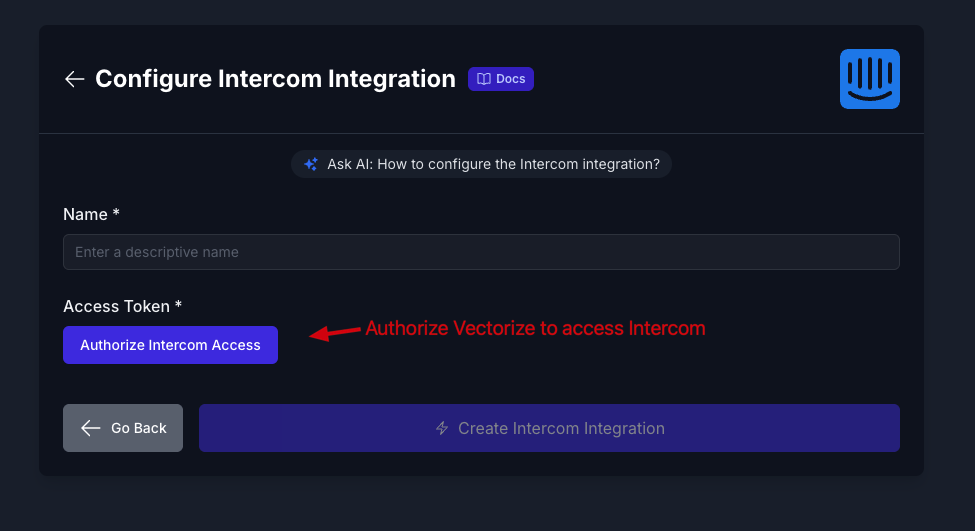
Enter a descriptive name for your connector.
-
Click Authorize to initiate the OAuth flow. This will redirect you to Intercom's authorization page.
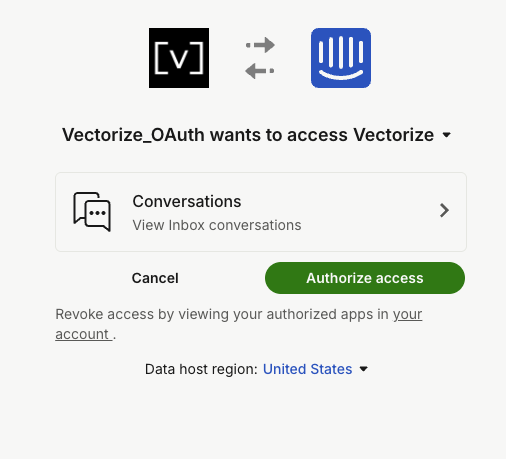
- Follow the OAuth flow to authorize Vectorize to access your Intercom data. You will be prompted to log in to your Intercom account and grant permissions.
Configuring the Intercom Connector in a Pipeline
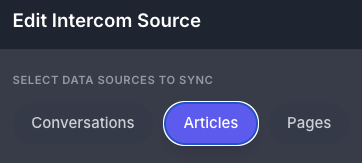
When configuring the Intercom connector in a pipeline, you can specify options organized into three tabs: Conversations, Articles, and Pages.
Conversations Tab
Content Selection
- Include Conversations: Import customer support conversations (default: enabled). Conversations contain message threads, customer interactions, and support history.
Conversation Filtering Options
Date Filters
- Created After: Filter for conversations created after this date (default: today's date, format: YYYY-MM-DD)
- Updated After: Filter for conversations updated after this date (optional, format: YYYY-MM-DD)
Status Filters
- Conversation State: Filter conversations by their current state:
- Open: Active conversations
- Closed: Resolved conversations
- Snoozed: Temporarily deferred conversations
- Select multiple states or leave empty for all states (default: all states)
Advanced Options
- Lookup Contact Details: Enrich conversations with detailed contact information (default: disabled). Note that enabling this option may increase processing time.
Articles Tab
Article Types
- Include Public Articles: Import public help center articles from your knowledge base (default: disabled)
- Include Private Articles: Import internal/private articles (requires appropriate permissions, default: disabled)
Article Filtering Options
Search Filters
- Public Article Search Phrase: Search for public articles containing specific phrases (e.g., "billing", "pricing", "setup"). Leave empty to include all articles.
Status Filters
- Public Article State: Filter public articles by their publication state:
- Published: Only published articles (default)
- Draft: Only draft articles
- All: All articles regardless of state
Collection Filters
- Public Article Collection Names: Filter public articles by collection names. Enter one or more collection names to import only articles from those collections (includes all child collections). Leave empty to include all collections.
Pages Tab
External Content
- Include External Pages: Import external pages and sites indexed by Intercom (default: disabled). This includes websites and external content that Intercom has crawled and indexed for your help center.
Use Cases
Customer Support Analysis
When setting up an Intercom connector for analyzing customer support patterns, you would typically:
- Enable Include Conversations to capture all conversation data
- Set Created After Date to focus on recent conversations (e.g., last 30 days)
- Filter by State to include "Open" and "Snoozed" conversations to focus on active support needs
- Enable Lookup Contact Details to enrich conversations with full customer context
- Leave Articles disabled unless you also want to analyze knowledge base content
This approach ensures you capture relevant support conversations with the context needed for AI-powered analysis and response suggestions.
Knowledge Base Search
For building a searchable knowledge base:
- Disable Include Conversations to focus only on knowledge content
- Enable Include Public Articles to import help center content
- Filter by Article State to include only "Published" articles
- Use Article Search Phrase to focus on specific topics (e.g., "API", "integration")
- Filter by Collection Names to include specific sections of your help center
This creates a searchable knowledge base from your published help content that can power AI-driven support responses.
Comprehensive Support Data
For a complete view of your support ecosystem:
- Enable Include Conversations to capture customer interactions
- Enable Include Public Articles to include help content
- Enable Include Private Articles to include internal documentation
- Enable Include External Pages to include any external resources indexed by Intercom
- Set appropriate date ranges to control the volume of data
This comprehensive approach provides AI systems with full context across all your support channels and documentation.
What's next?
- If you haven't yet built a connector to your vector database, go to Connect Your Data and select the platform you prefer to use for storing output vectors. OR
- If you're ready to start producing vector embeddings from your input data, head to Pipeline Basics. Select your new Intercom connector as the data source to begin using it in your pipeline.